Bending Reference
Conduit Bending Cheat Sheet
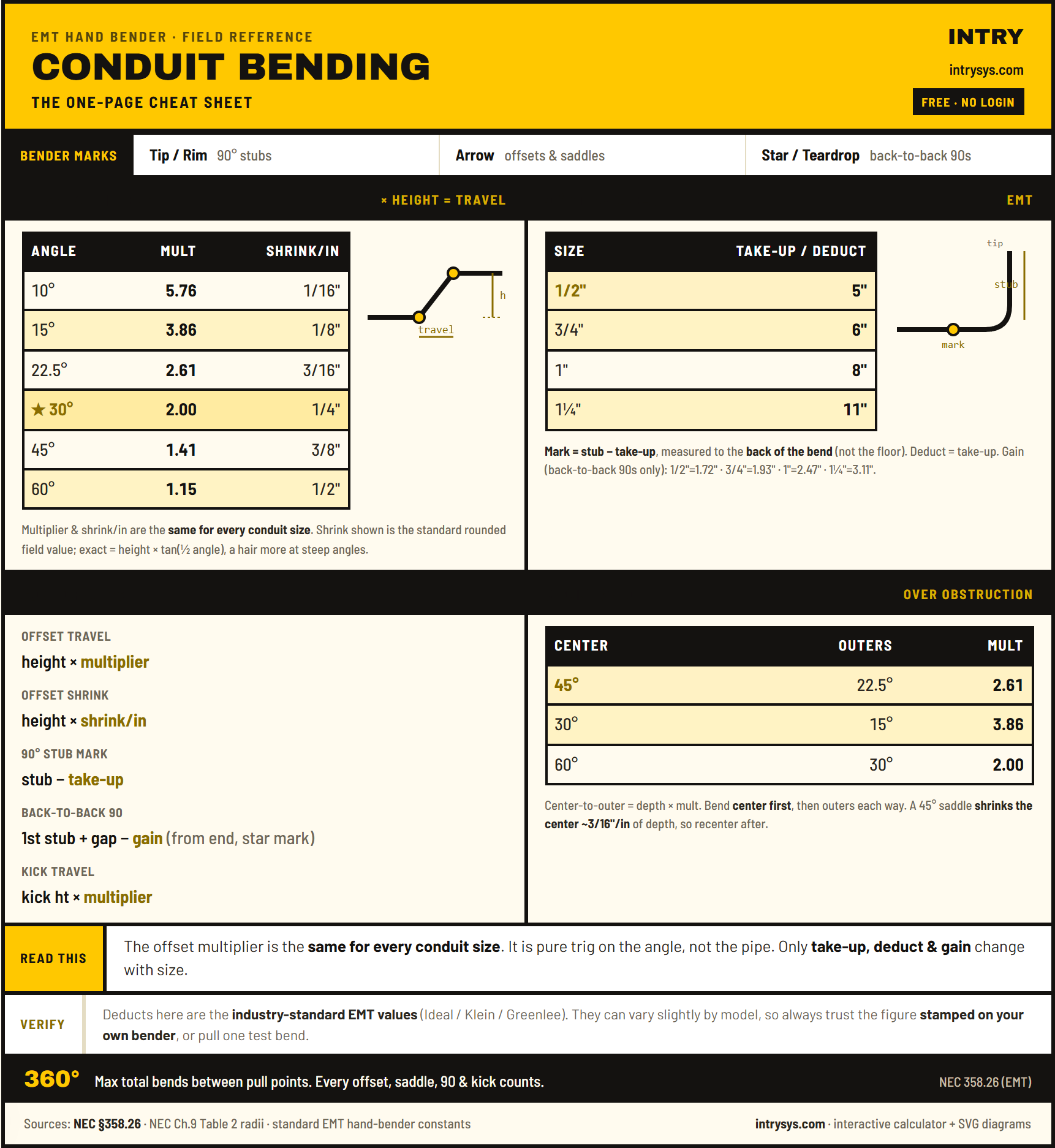
Every EMT hand-bender constant you use on the job, on one page. Offset multipliers, take-up and deduct, shrink per inch, saddle and kick math, and the NEC 360-degree rule. Print it, save the PDF, or download the image for your phone. Free, no login.
EMT Hand Bender · Field Reference
Conduit Bending
The One-Page Cheat Sheet
Offset Multipliers
× height = travel| Angle | Mult | 1/sin | Shrink/in |
|---|---|---|---|
| 10° | 6.0 | 5.76 | 1/16" |
| 15° | 3.86 | 3.86 | 0.132 |
| 22.5° | 2.6 | 2.61 | 3/16" |
| ★ 30° | 2.0 | 2.00 | 1/4" |
| 45° | 1.4 | 1.41 | 3/8" |
| 60° | 1.2 | 1.15 | 1/2" |
The charted multiplier & shrink/in are the same for every conduit size. Multipliers shown are the bender-manufacturer chart values (6.0 at 10°, 2.6 at 22.5°, 2.0 at 30°, 1.4 at 45°, and 1.2 at 60°), the rounded 1/sin, and they are what the calculator applies; 15° has no chart row, so it shows the exact 1/sin. Shrink shown is the bender-manufacturer chart value, which is what the calculator applies. Working it from the angle alone (height × tan(½ angle)) gives a higher number, because that treats the bend as a square corner with no radius; at 60° it runs about a third high against a real bend. Use the chart.
90° Stub · Take-Up
EMT| Size | Take-up / Deduct |
|---|---|
| 1/2" | 5" |
| 3/4" | 6" |
| 1" | 8" |
| 1¼" | 11" |
Mark = stub − take-up, measured to the back of the bend (not the floor). Deduct = take-up. Gain (outside corner, for developed length & back-to-back 90s): 1/2"=2.42" · 3/4"=2.85" · 1"=3.63" · 1¼"=4.62".
Core Formulas
3-Point Saddle
over obstruction| Center | Outers | Mult | 1/sin |
|---|---|---|---|
| 45° | 22.5° | 2.5 | 2.61 |
| 30° | 15° | 3.86 | 3.86 |
| 60° | 30° | 2.0 | 2.00 |
Center-to-outer = depth × mult (the bender saddle table at 45° and 60°; exact 1/sin elsewhere). Bend center first, then outers each way. A 45° saddle shrinks the center ~3/16"/in of depth, so recenter after.
The offset multiplier is the same for every conduit size. It is set by the angle, not the pipe. Take-up, deduct & gain change with size, and so does whether a bend can be made at all: the size's bend radius sets the smallest offset, saddle or kick.
Deducts here are Klein and Gardner Bender's published values for 1/2", 3/4", 1", and an unconfirmed field value for 1-1/4". They can vary slightly by model, so always trust the figure stamped on your own bender, or pull one test bend.
Go deeper on any bend
The sheet is the quick reference. Each page below has the full chart, a live calculator, and worked examples for that bend.
Offset Multiplier Chart
Full multiplier and shrink tables for 10 to 60 degrees, with travel tables and the formula for any angle.
90° Deduction Chart
Take-up, deduct, radius, and gain for 1/2" through 1-1/4" EMT, explained.
Conduit Shrink Calculator
Shrink per inch of offset and kick by angle, and why pipe size does not change it.
Saddle Bend Calculator
3-point and 4-point saddle marks, spacing multipliers, and center shrink.
Kick 90 Calculator
Kick marks, travel, and shrink per inch of kick for stub-and-kick combos.
Conduit Bending Calculator
Every bend family the calculator carries as an interactive 3D rendering or flat diagram, with verified bender profiles.